


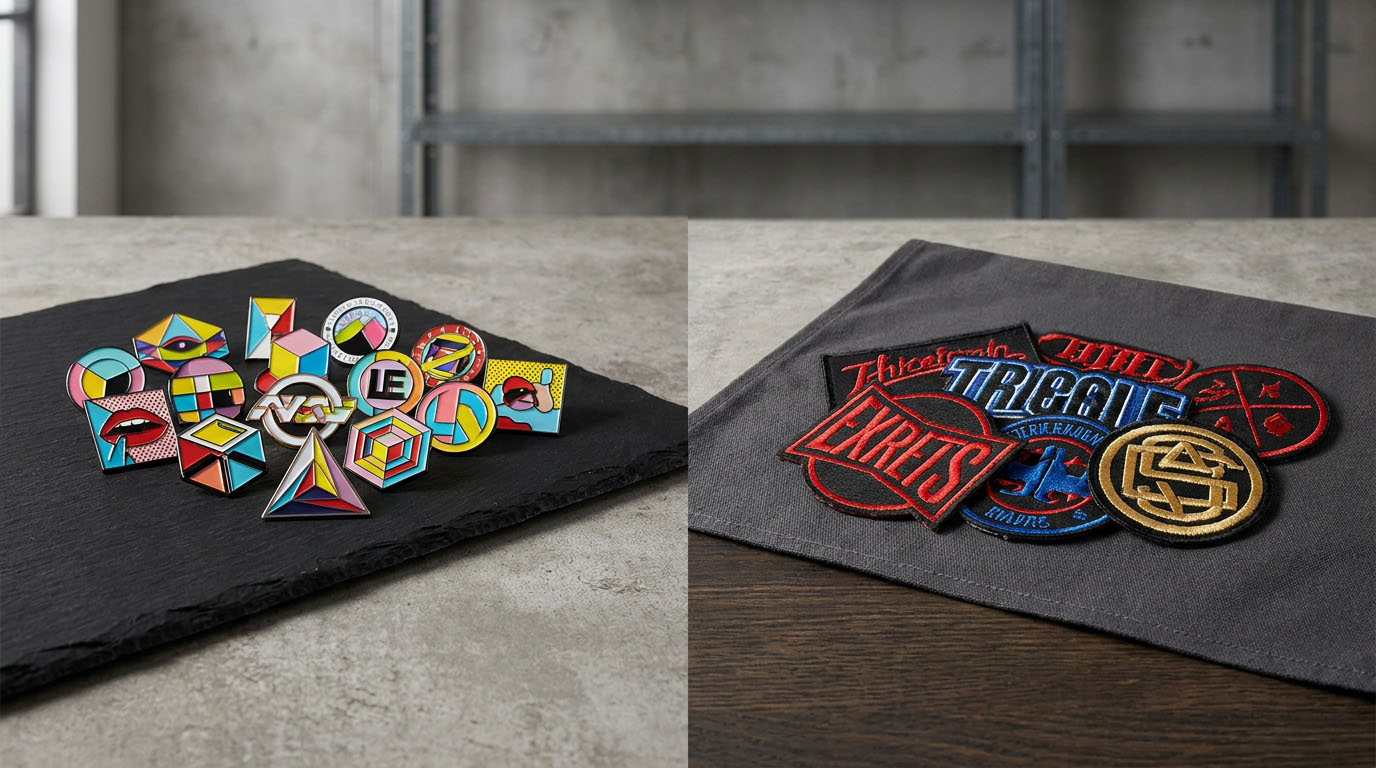
Your brand needs accessories that actually matter. Not just merchandise that gets tossed in a drawer or forgotten in a pocket.
When you're deciding between custom pins and custom patches, you're really asking: what's going to make people notice my brand? Both can work, but they work differently. And in a market where everyone's fighting for attention, that difference matters.
We've produced thousands of pins and patches for brands around the world, and the brands that succeed with either option understand one thing: it's not just about getting your logo on something. It's about creating something people actually want to wear.
Let's break down how pins and patches stack up when you need branding accessories that stand out.
The Style Factor: How Each One Hits Different
Custom pins bring clean, sharp precision. They sit on the surface of whatever they're attached to, creating a defined focal point. Think lapel pins on blazers, enamel pins on denim jackets, or collector pins on backpacks. Pins have a jewelry-like quality that can elevate an outfit or add a professional finish.
Custom patches integrate with the fabric itself. Whether they're sewn on or ironed on, they become a part of the garment. Patches have that authentic streetwear vibe that pins can't replicate. They're a part of custom clothing and urban culture, and they show up in various markets.
The visual impact depends entirely on your brand aesthetic. If you're going for sleek, minimal, or professional, pins often deliver better. If your brand lives in the world of streetwear, workwear, or casual culture, patches usually feel more authentic.
Durability and Longevity: What Actually Lasts
This is where the construction differences really show up in real-world use.
Custom pins are built to last decades when they're made right. Hard enamel pins especially can handle serious abuse. The metal backing means they won't tear, fade, or deteriorate from washing. We've seen 20-year-old enamel pins that still look fresh.
But pins have failure points. The pin post can bend or break. The clutch backing can wear out or get lost. And if someone catches a pin on something, it can damage the garment it's attached to.
Custom patches live and die by their attachment method and construction quality. A well-made embroidered patch with proper backing will survive years of washing and wear. But cheap patches with poor thread quality or weak adhesive will start looking rough within months.
Iron-on patches are convenient but less permanent. Sew-on patches require more effort but create a stronger bond. Heat-sealed patches offer the best of both worlds when done properly.
Cost Analysis: What You Actually Pay For
Custom pins generally cost more per piece, especially for hard enamel or intricate designs. But that higher cost often delivers better perceived value. People treat pins differently than patches. They collect them, display them, and trade them.
Complex pin designs with multiple colors or special finishes can get expensive quickly. Simple designs keep costs reasonable while still delivering that premium feel.
Custom patches offer more bang for your buck on larger volume orders. The per-piece cost drops significantly as quantities increase. For large promotional runs or team merchandise, patches usually win on pure economics.
But factor in attachment costs if you're having patches professionally applied. Iron-on patches can be applied by end users, but sew-on patches often need professional application for the best results.
Application and Versatility: Where Each One Works
Pins work on anything with fabric or a surface that can take a small puncture. Clothing, bags, hats, banners, even wooden displays. That versatility is powerful for brands that want one promotional item that works across multiple contexts. Options are even available to add keyrings, and jump rings for making custom charms and keychains.
Pins give instant gratification. There is no need for tools, heat, or a sewing machine. People can add pins to their gear immediately, and enjoy them right away.
Patches need compatible surfaces. They work great on fabric but typically cannot be applied on hard surfaces. However, on the right materials, patches can cover larger areas and make bigger visual statements than pins typically can.
Patches also offer size flexibility that pins don't. You can create large oversized back patches or tiny accent patches with equal effectiveness.
Brand Expression: What Story Each One Tells
Custom pins and patches provide different approaching to brand expression. They often bring different experiences to target customers and audiences.
Pins suggest precision, attention to detail, and often a bit of formality. Even casual enamel pins carry an implication that someone took care to create something permanent and refined. For professional brands, pins can bridge the gap between a promotional item and an accessory.
Patches signal authenticity, customization, and often rebellion or individuality. They've got that DIY, maker, streetwear energy that can't be faked. For brands that live in creative or alternative spaces, patches are a classic.

Consider your target customer. Are they more likely to put a pin on their laptop bag for work, or sew a patch onto their denim jacket for the weekend? That difference in context shapes how your brand gets experienced.
Design Considerations: What Works Best Where
Pin designs need to work at small scales. Fine details can get lost in enamel production or become fragile points on soft enamel pins. Bold, simple designs with clear contrast work best.
Text on pins should be minimal and highly legible. Complex typography often doesn't translate well to pin production, especially at smaller sizes.
Patch designs can handle more complexity because the embroidery, weaving, or printing process can capture finer details. Text works well on patches, and you can include more information without sacrificing readability.
Color gradients and photographic elements work better on patches than pins, especially if you're using printed or sublimated patches rather than traditional weaving or embroidery.
When Pins Make More Sense
Choose custom pins when you want:
- Maximum versatility across different surfaces and contexts
- A premium, jewelry-like feel that suggests quality
- Something people can apply instantly without tools or additional equipment
- Designs that work well at small scales with bold, simple graphics
- Promotional items that work in professional or formal settings
- Collectible appeal that encourages repeat engagement
Pins excel for corporate gifts, event merchandise, employee recognition, or any situation where you want something that feels substantial and permanent.

When Patches Are the Better Choice
Go with custom patches when you need:
- Integration with fabric for that authentic streetwear feel
- Larger design areas for complex graphics or detailed text
- Cost-effective solutions for large promotional runs
- Items that can handle machine washing and regular wear
- Designs with many colors or photographic elements
- Appeal to customers who value customization and DIY culture
Patches work perfectly for team uniforms, promotional merchandise, brand collaborations, or any scenario where you want to tap into streetwear and custom culture.
Hybrid Strategies: Using Both
Many successful brands don't choose one or the other. They use pins and patches for different purposes within their overall brand strategy.
Launch a pin for your core logo that works across all contexts, then create limited-edition patches for specific collections or collaborations. Use pins for professional merchandise and patches for lifestyle products.
This approach lets you hit different customer markets and use cases without sacrificing your brand message.
Quality Standards: What to Demand
Whether you choose pins or patches, quality matters more than price. Cheap promotional items that break or look poor reflect badly on your brand, regardless of how little they cost.
For pins, insist on proper plating, quality enamel, and durable attachment hardware. For patches, demand high thread quality, proper backing, and clean edge finishing.
Work with suppliers who understand the difference between promotional trinkets and brand assets. Your logo deserves better than low-tier production.
Making the Call
The choice between custom pins and patches comes down to brand positioning, target audience, and intended use. Both can be powerful brand tools when executed properly.
Consider your brand's personality, your customers' lifestyle, and where these items will actually be used. A finance company might choose pins for professional networking events. A skateboard brand would probably go with patches for an authentic urban style.
At New York Custom Labels, we've produced both pins and patches for brands ranging from Fortune 500 companies to independent streetwear labels. The most successful brands understand that these aren't just promotional items. They're brand extensions that stick with someone through their daily life.
Whether you choose pins for their versatility and premium feel, or patches for their integration and visual impact, make sure you're creating something people actually want to wear. That's the only way promotional products become brand ambassadors.
Ready to create custom pins or patches that people will actually use? Get in touch for a free quote and let's build something that represents your brand the right way.
The information below is required for social login
Sign In
Create New Account