


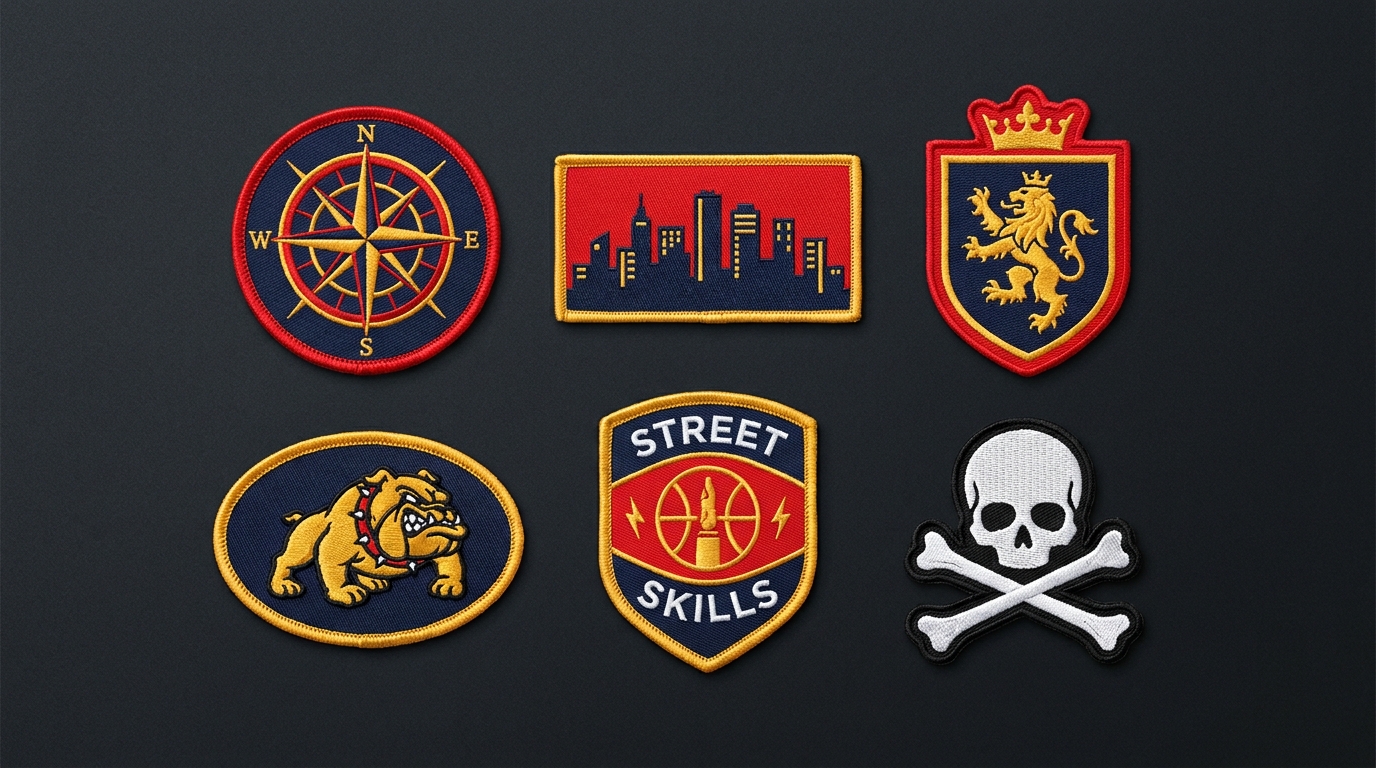
The wrong shape can totally change a good patch. You can have the cleanest embroidery, the right colorway, the perfect placement on a drop-shoulder jacket. If the outline fights the artwork, the whole thing falls flat. Shape is a design decision, not a formatting choice you make after the art is done.
Most brands think about shape last. They finalize the artwork, lock the colors, pick the size, and then ask: "What shape should it be?" That order is backwards. Shape affects how your art reads at a distance, how it sits on the garment, and what it costs to produce. Those three factors are connected. Get one wrong and you're either remaking samples or selling a patch that doesn't look like your mock-up.
Here's the breakdown. Shape by shape, finishing by finishing, placement by placement.
Why Shape Matters More Than You Think
Shape does a job before anyone reads the artwork. At a glance, from across the room, the outline is what registers first. A circle reads as a crest or a badge. A rectangle reads as structured and intentional. A custom laser cut shape of a hand or a skull reads as raw and custom. Your audience processes the shape before they process anything inside it.
This matters especially on apparel because patches are often seen in motion: on a jacket moving through a crowd, on a hat photographed at an angle, on a sleeve in a video. The shape needs to communicate clearly in those conditions, not just on a clean flat-lay.
There's also a production reality. Complex outlines with tight curves, thin bridges, or extremely fine points require more cut time and more precision at the finishing stage. A circular patch with a clean merrow border is one of the simplest things to make. A laser cut with five points and internal voids is one of the most technically demanding. Knowing the complexity of your shape early saves you from getting a quote at the end of the process that blows your budget.
The Standard Patch Shapes and What Each One Does
Circle and Oval. The circle is the most forgiving shape in production and the most versatile in application. It reads clearly at every size, from a 1-inch hat patch to a 5-inch back panel piece. Circular patches have defined military, athletic, and institutional design for over a century because they work. Crests, logos, single-subject illustrations: the circle handles all of it without a lot of wasted border space.
Ovals work better when the artwork is naturally horizontal. A wordmark that's wider than it is tall sits cleanly in an oval without the awkward margin you'd see if you forced it into a circle. Ovals also photograph well on sleeves, where the vertical surface of the arm gives the shape room to read properly.
Rectangle and Square. Clean, minimal, controlled. Rectangles are native to wordmarks, text-heavy designs, and anything that needs a structured, institutional feel. They photograph flat and stack well in grid layouts, which matters when you're building lookbook content or product shots for a drop announcement.
The trade-off: a rectangle with weak art just looks like a rectangle. This shape gives the design nowhere to hide. Strong, confident artwork works well here. Filler art doesn't.
Shield and Crest. The classics. Shields borrow from military patches, collegiate crests, and biker club design, all sources with strong visual authority. The shape signals history, even on a brand that launched six months ago. That's the value: shields communicate that something has been around long enough to earn a crest.
Streetwear and workwear brands use shield shapes constantly because the shape is premium without being corporate. It sits best on the chest or upper sleeve.
Custom Laser Cut. A laser cut patch follows the exact silhouette of the artwork. A rose patch shaped like a rose. A crown shaped like a crown. No rectangular or circular border, no empty merrowed edge surrounding the design. The outline is the design.
Laser cuts are the most expressive shape option and the most technically demanding to execute correctly. Artwork needs clean, closed outer shapes with no extremely thin bridges or fragile points. A design with spokes that are 2mm wide will not survive production intact. The design needs to be engineered for the format. Always discuss laser cut artwork with your sales rep before finalizing it. We review artwork before quoting, and flagging structural issues early saves a full sample revision later.
Edge Finishes: Merrow, and Laser Cut
The shape of the patch and the finish of the edge are two separate decisions, and they're connected. Not every finish works on every shape.
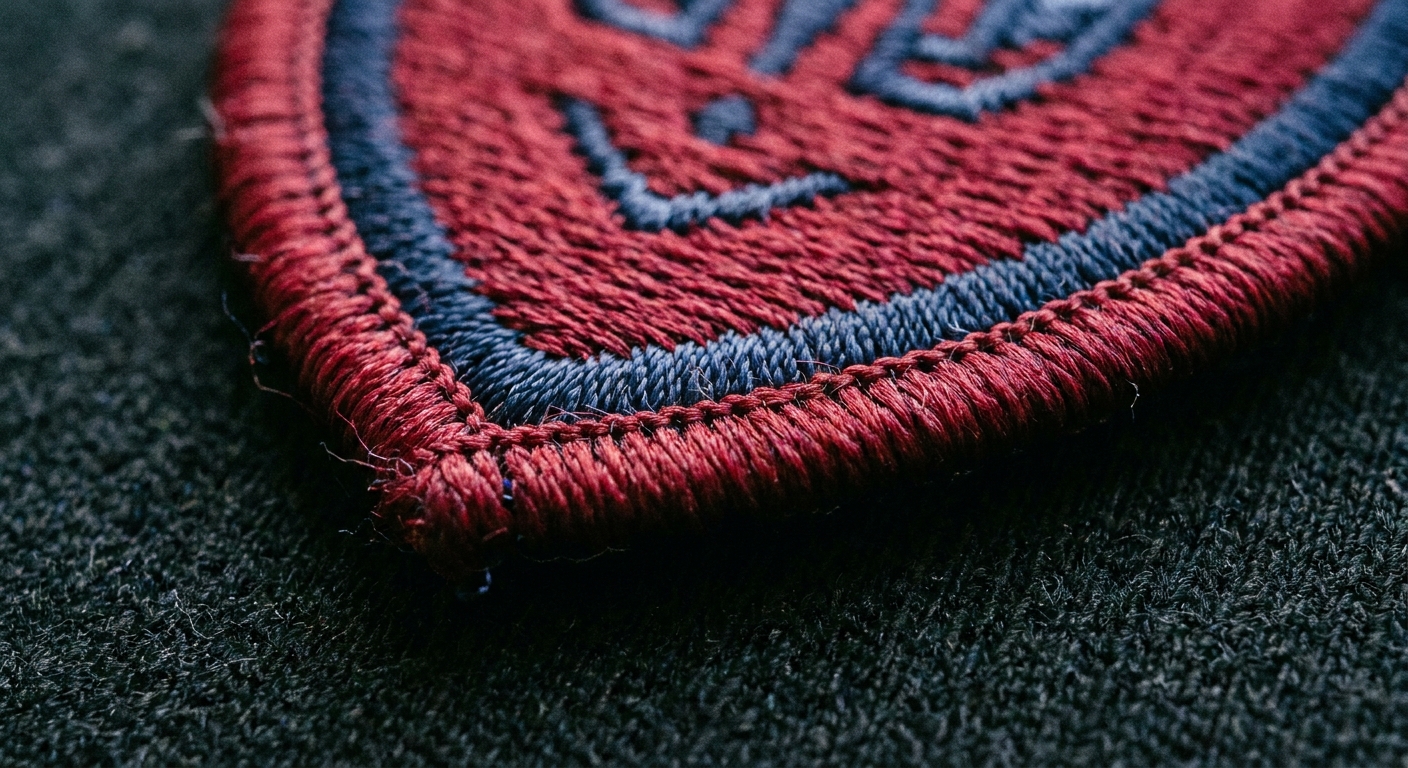
Merrow border is the coiled thread edge you see on most traditional embroidered patches. It's durable, hides the cut edge cleanly, and works on circles, rectangles, shields, and most simple custom shapes. It's the default for embroidered production for a reason: it holds up through washing, wearing, and years of use.
Merrow has limits. Very tight curves and sharp concave points are difficult to execute cleanly in a merrowed edge. On complex custom shapes, the thread can bunch or pull away. For those shapes, a different finish makes more sense.
Laser cut is the most precise option for geometric and detailed custom shapes. The cut is clean, sharp, and exact. No thread border, just a clean, sealed outline of the design. Laser cut edges are the best choice when precision is more important than a textured edge.
If you're planning a custom laser cut, bring up the finishing method at the quote stage. Assuming one and getting another is a common mistake on first orders, and it affects both the cost and the final look significantly.
Placement Shapes Your Shape Choice
A patch lives on a garment. The garment determines what shape works and what doesn't. Before you lock the outline, know where the patch is going.
Chest patches favor circles, shields, and squares. The chest is a high-visibility zone with roughly square proportions. Wide horizontal patches across the chest fight the natural line of the body. A circle or shield in the upper left chest reads naturally and cleanly.
Sleeve patches favor vertical shapes: rectangles, ovals, and tall custom shapes. Sleeves are vertical real estate. A patch that's taller than it is wide uses the sleeve surface efficiently and reads correctly when the arm is hanging or at an angle.
Back panels open up the shape options. You have more surface area on the back of a jacket or hoodie than anywhere else on the garment. Large patches, complex shapes, and designs that wouldn't work at smaller sizes all have room to breathe on a back panel. This is where you put the artwork that's too detailed for the chest.
Hat patches are constrained by the front panel. Most structured hats give you about 2 to 3 inches of width. Circles, small ovals, and compact shields are the workhorses here. Irregular or wide shapes on a hat often look unintentional. Design to the surface.
Our embroidered patches come in a full range of shapes sized and finished for every placement. If you're not sure what reads best for your garment, we can pull references and walk you through it before you commit to a design direction.
Sizing and What Scale Does to a Shape
Shape communicates scale, and scale changes how the shape is read. The same circle at 1.5 inches and at 4 inches are two completely different statements on a garment. One is a subtle brand mark. The other is the focal point of the piece.
Under 2 inches, detail disappears. Fine embroidery, complex borders, and intricate artwork collapse into visual noise at small scales. Circles and simple shapes with bold, high-contrast artwork work best. Less is always more at this size.
2 to 4 inches is the most versatile range. Most shapes work. Most placements work. This is where you have the most creative flexibility without fighting scale constraints. If you're not sure what size to start with, start here.
4 inches and up, you're making a statement. Big patches belong on back panels, large sleeves, or oversized outerwear. At this scale, the shape needs to be strong enough to hold empty space without looking unfinished. Simpler shapes with detailed artwork or complex shapes with bold art: both work. A weak shape with weak art at this size just looks like a mistake.
Starting at 5 pieces minimum for most patch types, ordering a sample before your full run is the right move. A sample tells you more than any digital mock-up ever will. The embroidery texture, the border color, the way the shape sits on the garment: none of that comes through on a screen.
Building a Patch Series: Shape as the Constant
One patch is a product. A series is a brand system.
The brands that do this best pick one design element to keep consistent across every release in a series, and shape is the easiest element to lock in. Every patch in the series shares the same shield outline. Different artwork, different colorway, different drop. But the same shape ties them together visually. After three or four releases, customers know what to expect. They're collecting shapes, not just patches.
This logic works for any shape: the shield, the laser cut skull, the circle with a specific border treatment. Pick the shape, commit to it for the series, and let the artwork evolve. The shape is the constant that makes the series feel intentional rather than random.
It also simplifies reorders. You're not re-engineering the shape every time. You update the artwork, keep the spec the same, and place the order. Production stays efficient and the brand identity stays consistent.

Get a Quote Before You Fall in Love With a Design
Patch production starts at 5 pieces for most styles. You don't need a large commitment to figure out what works for your brand. Run a sample. Verify the shape in person. Then scale up.
Custom shapes and die cuts are quoted based on the artwork, not a flat rate. If your design is complex, get the quote before you finalize the art. We've been producing patches for brands since 2008, and we've seen every shape that works and every shape that doesn't. Bring us the concept and we'll tell you what's feasible, what it costs, and how to get the result you actually want.
Browse the full custom patches catalog to see shape options, sizes, and finishes across every patch type we carry. Free quotes, no commitment. Tell us the shape, the size, the placement, and the quantity, and we'll come back with the number.
The information below is required for social login
Sign In
Create New Account